
Air-Gapped Edge Computing: Deploying Without Cloud Dependencies in Manufacturing
Air-Gapped Edge Computing: Deploying Without Cloud Dependencies in Manufacturing
A practical, source-backed view of resilient industrial infrastructure, operational continuity, and local-first manufacturing architectures.
Why manufacturers are rethinking cloud dependence
Manufacturing environments operate differently from traditional enterprise IT systems. Production lines cannot pause because an external authentication service fails or internet connectivity becomes unstable. In sectors such as food processing, pharmaceuticals, aerospace, and critical infrastructure, operational continuity matters more than architectural trends. As a result, manufacturers are increasingly reevaluating how much operational infrastructure should depend on continuous cloud connectivity. The objective is not isolation for the sake of isolation. The objective is operational resilience.
What air-gapped edge computing actually means
Modern air-gapped manufacturing environments are not necessarily disconnected forever. Most facilities are designing systems capable of continuing operations without cloud access while maintaining local analytics, historians, visualization, AI inference, and operational workflows directly inside the facility.That distinction becomes critical when latency matters, production cannot stop, or cybersecurity requirements restrict outbound connectivity.
Industrial edge infrastructure can now support historians, MQTT brokers, OPC UA infrastructure, predictive maintenance models, MES integrations, and machine vision systems without requiring continuous cloud communication.
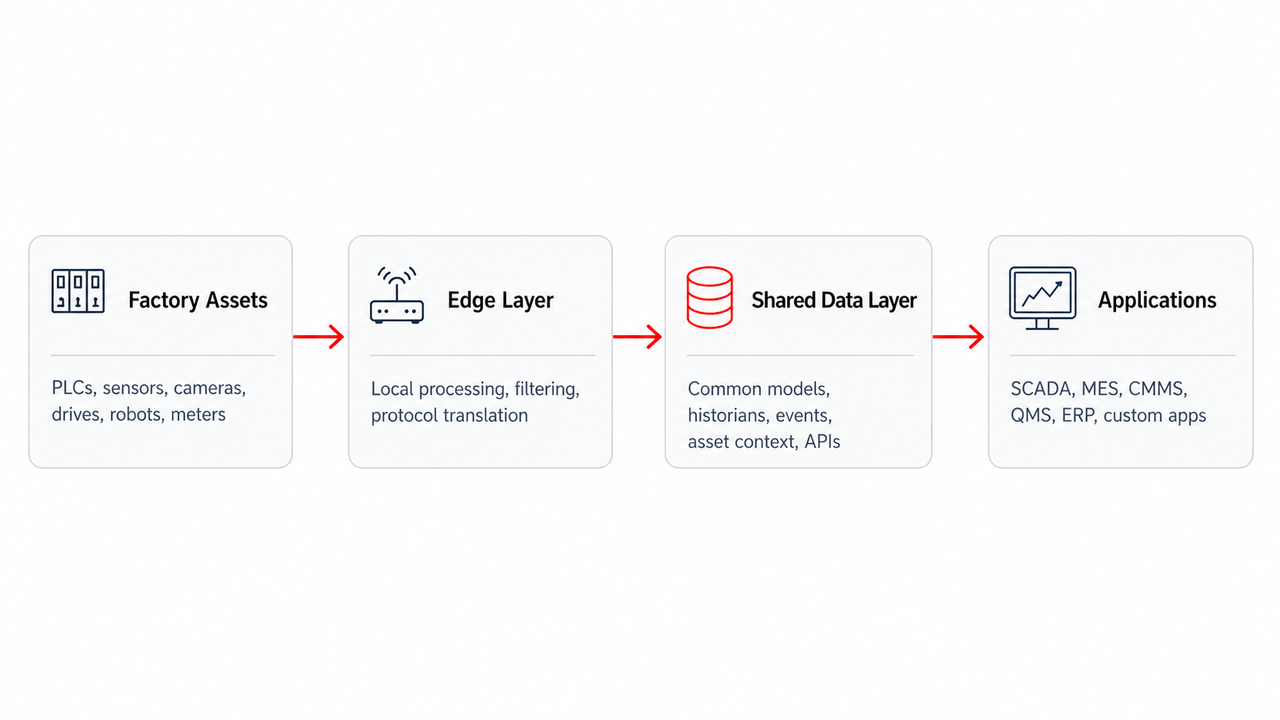
Manufacturers are no longer choosing between fully connected or fully isolated systems. The stronger operational pattern is becoming local-first infrastructure with controlled external synchronization.
Figure 1. A practical local-first architecture pattern for manufacturing operations.
Operational advantages of local-first architectures
Operations remain active during outages
HMIs, historians, and MES workflows continue functioning locally
Reduced operational risk and attack surface
Improved AI inspection and machine coordination
Stronger control of production data
Better protection of recipes and operational IP
Typical operational impact ranges
Figure 2. Directional impact ranges associated with local-first manufacturing initiatives.
The future of manufacturing infrastructure will not be defined by eliminating the cloud entirely. It will be defined by how effectively manufacturers balance operational intelligence with operational independence.Air-gapped edge computing allows facilities to maintain local visibility, analytics, and operational continuity while reducing unnecessary external dependencies.
Deloitte. Smart Manufacturing and Operations Survey.
World Economic Forum. Global Lighthouse Network Reports.
NIST Manufacturing and Industrial Edge Computing Research.
CISA Guidance for Operational Technology Environments.
ISA/IEC 62443 Industrial Cybersecurity Standards
Why Real-Time Monitoring is a Game-Changer for Electronics Manufacturing
How Automation Enhances Safety in Chemical Processing Plants
How Fireball Industries Helps Businesses Achieve Compliance Through Automation
Don't hesitate to contact us any time
Get in touch with us today to discuss your project and start building smarter solutions.
© 2025 Fireball. All Rights Reserved |
| #Automation Engineering #Controls Engineering #Factory 4.0 #Ignition #Node Red
Colonia Centro, CP 98000 Zacatecas, Mexico
Tired of costly proprietary tools and data lock-in, we built Fireball Industries to put control back in your hands. As a leading supplier of Industry 4.0 and IIoT solutions, we deliver scalable automation, expert consulting, and engineering services that empower you to own your digital future.
References
Deloitte. Smart Manufacturing and Operations Survey. https://www.deloitte.com/us/en/insights/industry/manufacturing/2025-smart-manufacturing-survey.html
IBM. Industry 4.0 Research. https://www.ibm.com/think/topics/industry-4-0
World Economic Forum. Global Lighthouse Network Reports. https://www.weforum.org/publications/global-lighthouse-network-rewiring-operations-for-resilience-and-impact-at-scale/
NIST Manufacturing and Industrial Edge Computing Research. https://www.nist.gov/manufacturing
CISA Guidance for Operational Technology Environments. https://www.cisa.gov/topics/critical-infrastructure-security-and-resilience/industrial-control-systems
ISA/IEC 62443 Industrial Cybersecurity Standards. https://www.isa.org/standards-and-publications/isa-standards/isa-iec-62443-series-of-standards