
Industry 4.0 in Practice: What Actually Changes Inside a Factory
Industry 4.0 in Practice: What Actually Changes Inside a Factory
A practical, source-backed view of connected operations, measurable value, and the path to a future-ready manufacturing environment.
Why Industry 4.0 is no longer a side project
Industry 4.0 is often discussed as if it were a technology package: sensors, dashboards, robots, artificial intelligence, cloud platforms, and digital twins. In practice, the term matters only when it changes how a factory makes decisions. A connected plant can see problems earlier, understand the operational context behind them, and respond before small deviations become costly downtime, scrap, or missed delivery commitments.
That distinction is important. Industry 4.0 is not simply “more automation.” Traditional automation can make a single process faster while the rest of the operation remains blind. A future-ready factory connects production, quality, maintenance, energy, and business data into a usable operating picture. IBM describes Industry 4.0 as the digital transformation of manufacturing that enables real-time decision-making, productivity, flexibility, and agility [2]. The point is not technology for its own sake; the point is operational response.
The value is real, but it is not automatic
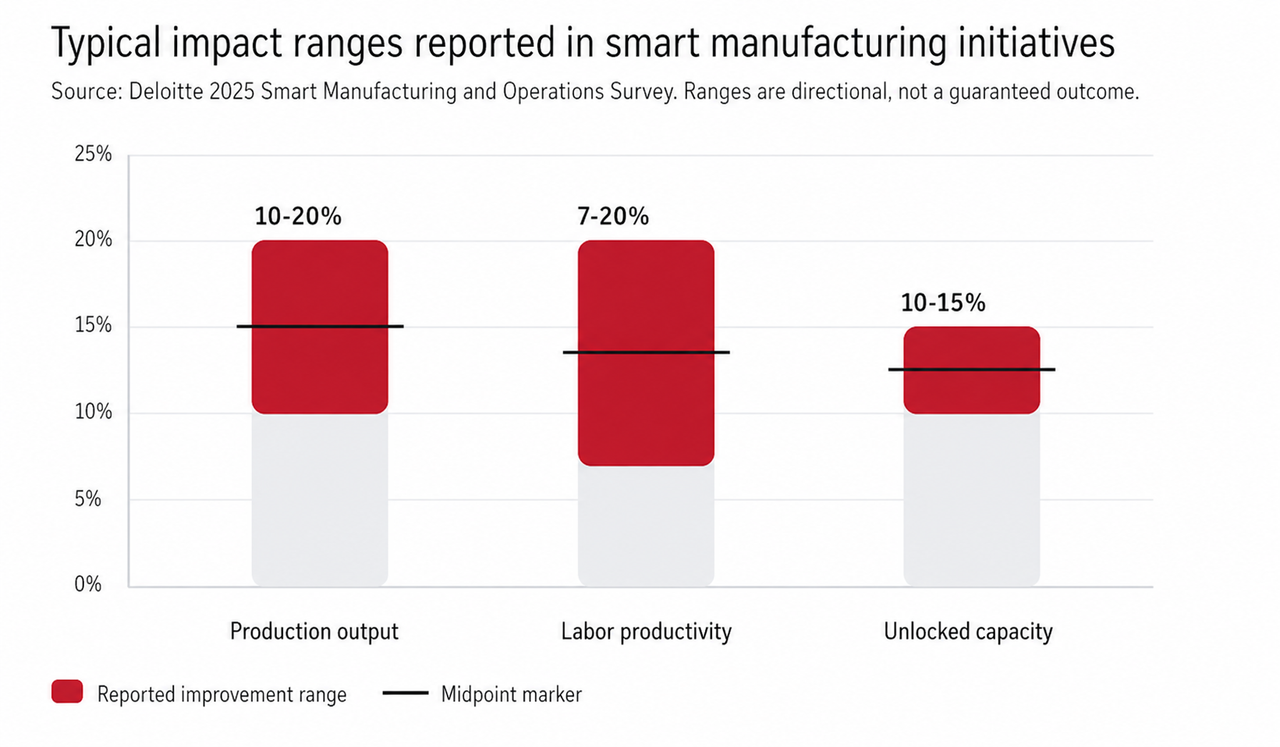
Deloitte's 2025 Smart Manufacturing and Operations Survey, based on 600 executives, found that 92% of respondents see smart manufacturing as the primary driver of competitiveness over the next three years [1]. The same research reports measurable gains among manufacturers already implementing these initiatives: 10-20% higher production output, 7-20% higher labor productivity, and 10-15% unlocked capacity [1].
Those numbers are useful because they set an order of magnitude for business cases. They should not be treated as universal promises. A plant with clean data, clear ownership, and a focused constraint will usually move faster than a plant trying to deploy a large platform without first defining the operational problem.
Figure 1. Directional impact ranges reported by Deloitte. The chart shows ranges, not guaranteed outcomes.
The technologies that matter most
Successful Industry 4.0 programs rarely depend on one tool. The stronger pattern is a stack of capabilities that are selected around a business constraint and then connected through reliable data flows.
Captures state, condition, events, energy, and traceability data.
Visibility, OEE, downtime analysis, maintenance context.
Processes data close to equipment where latency, uptime, or local autonomy matter.
Faster response, resilience, controlled data movement.
Scales analytics, historical analysis, governance, and multi-site visibility.
Benchmarking, enterprise reporting, advanced analytics.
Identifies patterns, defects, anomalies, and prediction signals.
Quality, scrap reduction, predictive maintenance, operator support.
Models processes or assets to test changes before physical disruption.
Lower commissioning risk, better process design, faster changeovers.
Automates repetitive, hazardous, or consistency-sensitive tasks.
Throughput, safety, repeatability, labor support.
Cybersecurity and OT/IT governance
Controls how systems, identities, data, and access connect.
Lower operational risk, safer scaling, clearer accountability.
What leading factories are doing differently
The World Economic Forum's Global Lighthouse Network is useful because it highlights sites that have moved beyond isolated pilots and scaled digital capabilities across operations. In 2026, the network expanded to 223 sites across more than 30 countries and 40 industries, emphasizing measurable impact across performance, people, and sustainability [3][4].
In practical terms, these facilities tend to share a few behaviors: they choose constrained use cases, combine technologies instead of treating them as separate initiatives, invest in people and process discipline, and measure impact with operational KPIs rather than vague transformation language.
What it looks like in the plant
A bottleneck machine, chronic downtime issue, quality escape, energy waste, or slow changeover.
Keeps scope tied to money, time, quality, or output.
Machine data is contextualized with maintenance, quality, schedule, and business systems.
Turns raw signals into decisions people can act on.
Use interoperable protocols, modular layers, and a clear data model.
Reduces lock-in and lowers the cost of future integration.
Measure adoption, not just installation
Track how operators, engineers, and supervisors actually use the system.
A dashboard nobody trusts or uses is not an operational improvement.
A practical architecture pattern
The architecture does not need to be complicated, but it does need to be intentional. A healthy pattern separates factory-floor data capture, edge processing, shared data models, business applications, and analytics. This makes it easier to start small without building a dead-end pilot.
Figure 2. A simplified architecture pattern for Industry 4.0. The goal is not a single tool; it is a connected decision environment.
How to avoid the “pilot forever” trap
Many Industry 4.0 initiatives stall because they begin as platform projects instead of operational projects. The team buys software, connects a few assets, builds a dashboard, and then struggles to prove why the work should expand. The better approach is less glamorous and more effective: start with a measurable pain point.
For example, a first initiative might target unplanned downtime on one critical line, high scrap at one inspection point, energy consumption on one utility-intensive process, or changeover losses in one product family. Once the constraint is clear, the technical scope becomes easier to defend: what data is needed, where it should be processed, which people need to act, and what KPI proves progress.
What is costing the plant money, time, quality, or capacity every week?
One prioritized use case and baseline KPI.
What signals are needed, and are they trustworthy?
Connected assets and validated data points.
Who receives the insight, when, and what action follows?
Alerts, dashboards, workflows, and ownership.
Did the KPI move enough to justify expansion?
Before/after results and a scale decision.
What must be reusable for the next line or site?
Data model, integration pattern, support process.
The future-ready factory will not be defined by who buys the most technology. It will be defined by who connects operations, people, and decisions with the least friction.
Industry 4.0 works when it becomes practical: fewer blind spots, faster response, better quality, more reliable assets, and a clearer line between engineering effort and business value. The next step is not to launch a massive transformation program. It is to choose one real constraint, measure it honestly, connect the right data, and scale only what proves useful.
2025 Smart Manufacturing and Operations Survey.
https://www.deloitte.com/us/en/insights/industry/manufacturing/2025-smart-manufacturing-survey.html
https://www.ibm.com/think/topics/industry-4-0
Global Lighthouse Network: Rewiring Operations for Resilience and Impact at Scale.
Global Lighthouse Network recognizes 23 new sites and launches AI platform.
https://www.nist.gov/el/applied-economics-office/manufacturing/topics-manufacturing/digital-twins
Digital Twins for AdvReferences[1] Deloitte. 2025 Smart Manufacturing and Operations Survey. https://www.deloitte.com/us/en/insights/industry/manufacturing/2025-smart-manufacturing-survey.html
[2] IBM. What is Industry 4.0? https://www.ibm.com/think/topics/industry-4-0
[3] World Economic Forum. Global Lighthouse Network: Rewiring Operations for Resilience and Impact at Scale. https://www.weforum.org/publications/global-lighthouse-network-rewiring-operations-for-resilience-and-impact-at-scale/
[4] World Economic Forum. Global Lighthouse Network recognizes 23 new sites and launches AI platform. https://www.weforum.org/press/2026/01/global-lighthouse-network-recognizes-23-new-sites-launches-ai-platform-for-industrial-transformation/
[5] NIST. Digital Twin Economics. https://www.nist.gov/el/applied-economics-office/manufacturing/topics-manufacturing/digital-twins
[6] NIST. Digital Twins for Advanced Manufacturing. https://www.nist.gov/programs-projects/digital-twins-advanced-manufacturing