
Managing edge devices that are never online
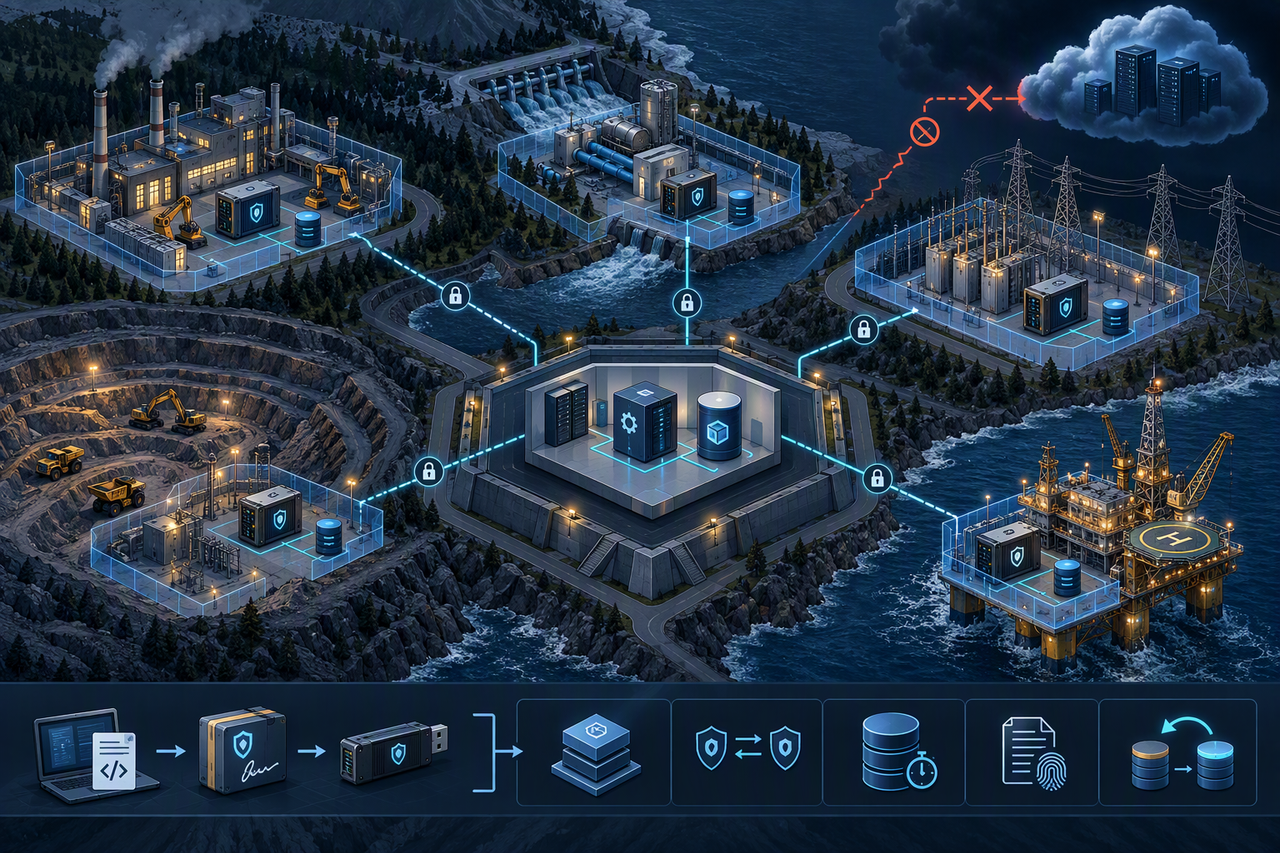
Most device-management tools are built on one quiet assumption: the device can reach a server. It checks in, pulls updates, reports health and accepts commands. On a plant floor, that assumption is often wrong, and it is wrong on purpose.
An edge node behind an air gap, at a remote pump station or inside a defense supplier's enclave may go months without a route to the internet. Sometimes it never gets one. Those devices still need patches, configuration changes, new applications and audit evidence. The question is how to manage a fleet that you cannot reach whenever you want.
This post covers why so many industrial edge devices stay offline, what breaks when your tooling assumes they won't, and the design principles that make offline-first management work.
Why edge devices stay offline
Offline is rarely an accident in operational technology. It is usually a decision someone made to protect production, data or people.
· Air-gapped networks. Defense suppliers, critical infrastructure and some pharma lines isolate control networks by policy or contract. Nothing crosses the gap without a person carrying it.
· Islanded and remote sites. Water and wastewater lift stations, substations, pipelines, mines and offshore assets run on cellular, radio or nothing at all. Links drop for hours or days.
· Segmented plants. Many factories split the network into zones. The edge node sits several layers below anything with an internet route, and opening a firewall rule takes a change request.
· Sovereignty and data rules. Some owners will not let production data leave the building, and some will not let a vendor's cloud talk to their floor at all.
· Uptime politics. On a line that earns money every minute, nobody wants a device rebooting because a cloud service decided it was patch night.
The result is a fleet where "connected" is the exception. Treating disconnection as a fault to be fixed misreads the environment.
What breaks when management assumes connectivity
Tools designed for laptops and cloud servers fail in predictable ways on an offline floor.

The common thread is that the device depends on something outside its own boundary to keep working. Remove the link and the device, or your view of it, goes dark.
Design principles for offline-first management
The fix is not better connectivity. It is a management model where the device is fully functional on its own, and the link is a convenience.
1. Nothing has to phone home. Licensing, runtime and local services keep working indefinitely with no outside contact. If a subscription or a WAN link lapses, the software already on the node keeps running.
2. Declare the desired state, then let the node converge. Store configuration as code in version control. Each node holds its target state locally and reconciles to it on its own, whether the next sync is in five minutes or five months. This is the GitOps pattern, and it suits disconnected sites well.
3. Run the control plane where the devices are. A small local cluster at each site schedules workloads, restarts failed containers and holds secrets. A central console is useful when it can see the site, not required for the site to operate.
4. Move updates as signed bundles. Package OS images, containers and config into a single signed artifact that can cross an air gap on approved media. The node verifies the signature before it applies anything, and can roll back to the last known-good image.
5. Bring your own registry and repo. Keep a local container registry and Git service inside the perimeter, so deployments never reach out to a public source.
6. Buffer telemetry, sync on reconnect. Store metrics and logs locally with timestamps, then forward them when a link appears. A message broker such as MQTT with store-and-forward handles this well.
7. Treat stale as a state, not an error. The console should show when each node last synced and what version it last reported, so operators can tell "offline by design" from "offline because it failed."
Security without a connection
An offline device can't count on a cloud security service to watch it, so the protection has to live on the node itself.
· Immutable, hardened OS. A read-only base image with atomic updates removes much of what ransomware and persistence techniques rely on. If something changes the system, a reboot returns it to the signed image.
· Zero trust, even inside the fence. Being on the plant network should not grant trust. Every service proves its identity with mutual TLS, and traffic is denied by default.
· No inbound ports. Nodes initiate any connection they make, outbound only. Nothing listens for the internet, so there is nothing for a scanner to find, and no VPN to maintain.
· Local identity that survives an outage. Keep local accounts and credentials that work when the identity provider is unreachable, and rotate keys and certificates on a schedule the site controls.
· Encryption that lasts. Devices in OT stay in service for 10 to 20 years. Data captured today may be decrypted later, so post-quantum cryptography is worth planning for now.
· Evidence on the box. Keep tamper-evident logs and configuration history locally. Frameworks such as CMMC expect proof of control, and an assessor won't accept "it was offline" as a reason for missing records.
A practical checklist
Use these questions to test any edge platform, or your current setup, against an offline reality.
☐ Unplug the WAN for 30 days. Does every workload, license and local service keep running?
☐ Can you apply a full OS and application update from removable media, with a signature check and rollback?
☐ Is every node's configuration in version control, and can you say which version runs on each one?
☐ Does each site have its own control plane, registry and secrets store?
☐ Are there zero inbound ports open on edge nodes?
☐ Do local logins work when the identity provider is down?
☐ Is telemetry buffered locally and forwarded when a link returns, with no gaps?
☐ Can the platform run your existing controllers and applications in place, without a rip-and-replace?
☐ Does it run on hardware you choose, so a vendor's box isn't the only option?
☐ If the vendor disappeared tomorrow, would the software on your floor keep running?
The takeaway
On the plant floor, a device that is never online is not a broken device. It is a design constraint. Platforms that treat connectivity as optional, keep state as code, run control locally and secure the node itself will manage that fleet well. Platforms that assume a link will keep fighting the environment they were sold into.
See it against your own constraint. If you are managing air-gapped, islanded or segmented edge devices, we'd be glad to walk through how an offline-first platform handles your setup. Book a demo or visit www.embernet.ai to learn more.