
The Purdue Model is Dead: EmberNet and the Zero-Trust Imperative for Industrial Operations
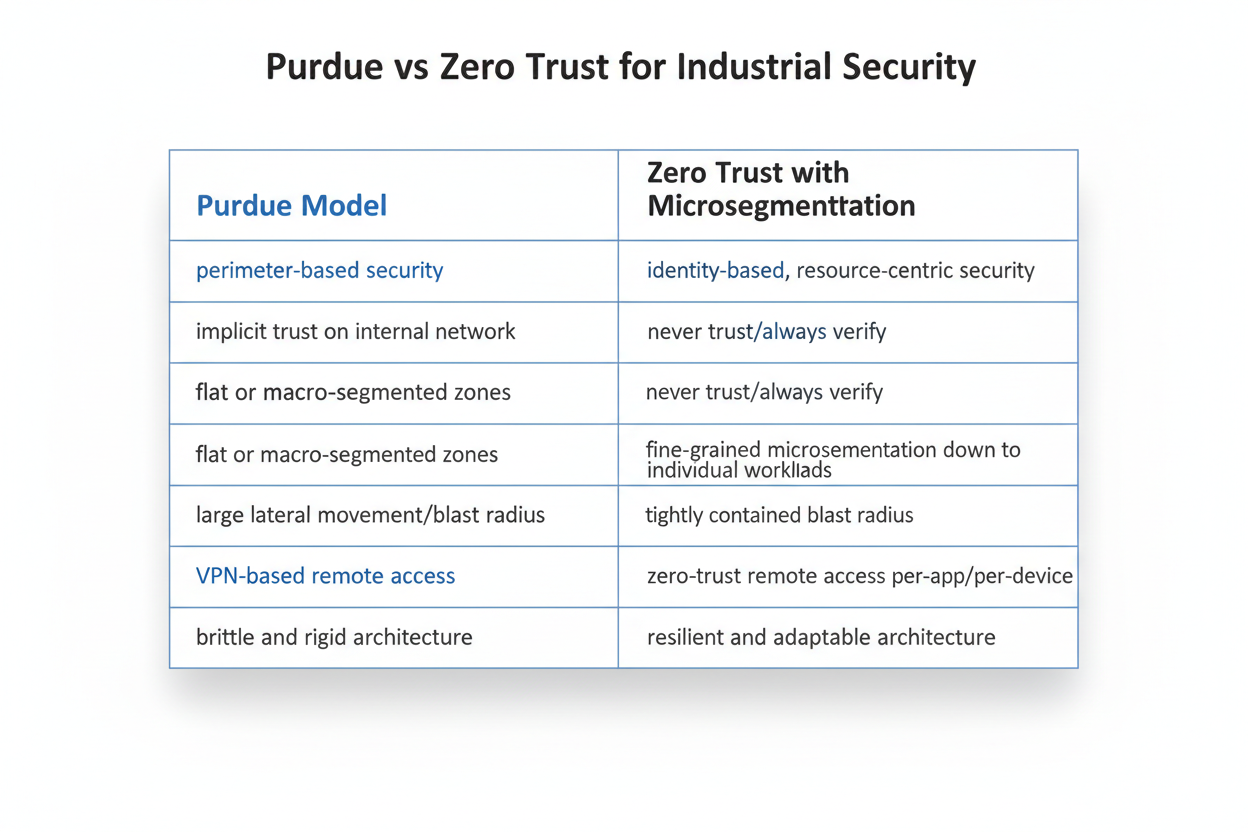
The Purdue Model is Dead: EmberNet and the Zero-Trust Imperative for Industrial Operations
For over three decades, the industrial world has operated under a dangerous delusion, clinging to the Purdue Enterprise Reference Architecture as a security framework. This report declares, without reservation, that this practice is no longer a conservative engineering choice but an act of profound professional malpractice. The Purdue Model, a relic from an era of isolated systems, is fundamentally broken, and its continued application in today's hyper-connected landscape is a direct and demonstrable threat to critical infrastructure, corporate solvency, and public safety. Adherence to this obsolete model is the equivalent of a structural engineer insisting on using 19th-century building codes in a modern earthquake zone; it is a willful disregard for evidence that guarantees catastrophic failure. The litany of devastating cyberattacks on industrial targets is not a series of unfortunate events but a predictable pattern of adversaries exploiting the architectural negligence inherent in the Purdue paradigm.
The era of perimeter-based security and implicit trust is over. The only professionally responsible path forward is a complete and uncompromising shift to a Zero Trust architecture. This is not an optional upgrade; it is an existential imperative. A Zero Trust model, founded on the principle of "never trust, always verify," accepts the stark reality that threats can and will exist everywhere, both inside and outside the network. It is the only strategy that provides meaningful resilience against the sophisticated, persistent threats targeting industrial operations today.
This report presents EmberNet as the reality-based alternative to the failed Purdue paradigm. EmberNet is a complete, hyper-converged infrastructure (HCI) platform engineered from the ground up for the unique demands of industrial operations. It is not an incremental improvement but a wholesale replacement, providing a secure, resilient, and agile foundation built on the core tenets of Zero Trust. The EmberNet platform consists of four integrated components: EmberOS, a tamper-proof immutable operating system that makes malware persistence a physical impossibility; EmberNet Forge, which automates secure hardware enrollment and configuration to eliminate human error; EmberNet Flux, a Zero Trust Networking fabric that provides granular microsegmentation to contain any breach instantly; and EmberNet Alloy, a self-healing container orchestration engine that ensures operational continuity. This is an urgent call to action. The choice is simple: continue signing the suicide pact of the Purdue Model and wait for the inevitable disaster, or embrace the Zero Trust imperative with EmberNet and choose survival.
Introduction: The Emperor Has No Clothes
For thirty years, the Purdue Model has been the revered icon of industrial network design, its layered diagram hanging on the walls of engineering departments like a sacred text. It has served as the foundation for cybersecurity standards that are, themselves, dangerously out of date. We are here to state, unequivocally, that the emperor has no clothes. The Purdue Model is dead. Its continued use as a security framework is the architectural equivalent of offering "thoughts and prayers" in the face of a category five hurricane—a well-intentioned but utterly powerless gesture against an overwhelming force. Any CISO, plant manager, or board member who continues to sanction its use is presiding over a ticking time bomb, and when it detonates, ignorance will not be a viable defense.
The model's genesis in the 1990s was innocent enough. It was an industrial engineering framework for organizing data flows in computer-integrated manufacturing, a concept from an era when the internet was a novelty and "cyber warfare" was the stuff of science fiction. Security practitioners, desperate for any kind of blueprint, later latched onto its hierarchical structure. They saw its neat layers and theoretical separation between Information Technology (IT) and Operational Technology (OT) as a convenient way to build a digital fortress. The problem is that the world has changed, the nature of warfare has changed, and the fortress they built is made of cardboard.
The core premise of the Purdue Model—that you can build a trusted, safe "inside" and an untrusted, dangerous "outside"—is a dangerous fantasy in the year 2026. The relentless drive for efficiency, remote access, cloud analytics, and the Industrial Internet of Things (IIoT) has not just blurred the lines between IT and OT; it has obliterated them. There is no "inside" anymore. Your network is a porous, dynamic, and constantly changing ecosystem of interconnected devices, many of which were never designed with security in mind. To assume anything within this ecosystem is "trusted" is an act of willful delusion that borders on the criminal.
This report will make the case for professional malpractice. We will demonstrate that the Purdue Model is not merely "showing its age" but is architecturally negligent. We will dissect its fatal flaws, not as theoretical weaknesses, but as the proven attack vectors used to hold national infrastructure hostage, shut down global food supplies, and attempt to poison municipal water systems. We will show how its rigid, brittle structure is fundamentally incompatible with the demands of modern industry and how its core assumptions create a highly flammable core, maximizing the blast radius of any successful breach.
Then, we will present the only viable alternative: a complete and total embrace of a Zero Trust security posture, implemented on a modern, hyper-converged foundation. This is the model the Department of Defense is adopting to protect its most critical assets, from nuclear silos to global logistics networks. If the Purdue Model isn't good enough for the DoD, why in God's name do you think it's good enough for your power plant, your factory, or your water utility? The time for polite debate and incremental change is over. It is time to choose a side: architectural negligence or reality-based security. It is time to introduce EmberNet.
Part I: The Purdue Model - Architectural Negligence
To fully grasp why the continued use of the Purdue Model constitutes professional malpractice, one must look beyond its familiar diagrams and confront the world it was born into. Conceived in the early 1990s by Theodore J. Williams and a university consortium, the Purdue Enterprise Reference Architecture (PERA) was an academic model for organizing data flows in a manufacturing environment. It was created before the commercial internet was a household utility, before the rise of global ransomware gangs, and before the concept of a persistent, motivated, and well-funded state-sponsored cyber adversary was a daily reality for every organization on the planet. Its adoption as a security framework was an accident of history, a convenient but ultimately disastrous repurposing of an industrial engineering diagram. The model's neat, hierarchical layers—from the physical process at Level 0 to the enterprise network at Level 5—provided a simple, visual map that was easy for engineers and managers to understand. It gave them a false sense of order and control. It allowed them to believe they could build a digital fortress with a deep moat, high walls, and a single, heavily guarded gate. This belief is now the single greatest threat to industrial operations worldwide. The model that was once a blueprint for order has become a predictable roadmap for attackers, and its foundational principles are now its fatal flaws.
Fatal Flaws with Aggressive Framing
The Purdue Model is built on a foundation of lies. These are not harmless white lies; they are dangerous, foundational delusions that create a security posture so fragile it shatters on Bibliography1. Introduction to ICS Security Part 2 - SANS Institute. https://www.sans.org/blog/introduction-to-ics-security-part-2
2. Purdue Enterprise Reference Architecture - Wikipedia. https://en.wikipedia.org/wiki/Purdue_Enterprise_Reference_Architecture
3. Is the Purdue Model Obsolete in the Era of IoT and Cloud Industrial Control Systems? - Medium. https://medium.com/@GurvinderPalSingh-TheCyberChef/is-the-purdue-model-obsolete-in-the-era-of-iot-and-cloud-industrial-control-systems-ics-5805d022ac4e
4. How hackers exploit critical infrastructure - Help Net Security. https://www.helpnetsecurity.com/2018/07/19/hackers-exploit-critical-infrastructure/
5. Industroyer2: How Ukraine avoided another blackout attack - TechTarget. https://www.techtarget.com/searchsecurity/news/252523694/Industroyer2-How-Ukraine-avoided-another-blackout-attack
6. IT, OT, and ZT: Implementing Zero Trust in Industrial Control Systems - Carnegie Mellon University SEI. https://www.sei.cmu.edu/blog/it-ot-and-zt-implementing-zero-trust-in-industrial-control-systems/
7. Zero Trust: The Essential Guide - Industrial Cyber. https://industrialcyber.co/zero-trust/zero-trust-the-essential-guide/
8. Zero Trust Adoption Statistics and Trends in 2025 - Expert Insights. https://expertinsights.com/zero-trust/zero-trust-adoption-statistics-and-trends
9. Zero Trust for Operational Technology (OT) Activities and Outcomes - DoD CIO. https://dodcio.defense.gov/Portals/0/Documents/Library/ZT-OperationalTechnologyActivitiesOutcomes.pdf
10. Immutable OS: a new paradigm for more secure and resilient systems - Worldline Tech Blog. https://blog.worldline.tech/2023/03/29/immutable_os.html
11. 3 Immutable Operating Systems: Bottlerocket, Flatcar and Talos Linux - The New Stack. https://thenewstack.io/3-immutable-operating-systems-bottlerocket-flatcar-and-talos-linux/
12. Edge to cloud: Understanding new industrial architectures - Control Engineering. https://www.controleng.com/edge-to-cloud-understanding-new-industrial-architectures/