What Happens to Your Production Line When the Software Vendor Goes Away?
It rarely starts with an alarm. More often, it's a routine email: a “product end-of-life notice,” or a press release saying your software vendor has been bought out and is “streamlining its product line.” Sometimes there isn't even an email — the vendor's support line just stops picking up.
For an office IT team, losing a software vendor is annoying but manageable: switch tools, move the data, move on. For a production line, it's a much bigger problem. That software might be running the screen an operator uses every day, talking to machines that are older than the software itself, and holding the only copy of a recipe or process that was never written down anywhere else. When the vendor disappears, the plant is stuck with equipment nobody can update, fix, or even fully explain anymore.
This isn't a rare, freak occurrence. It's a risk built into the way industrial software has traditionally been sold — and understanding why is the first step to protecting against it.
Factories and software age at different speeds
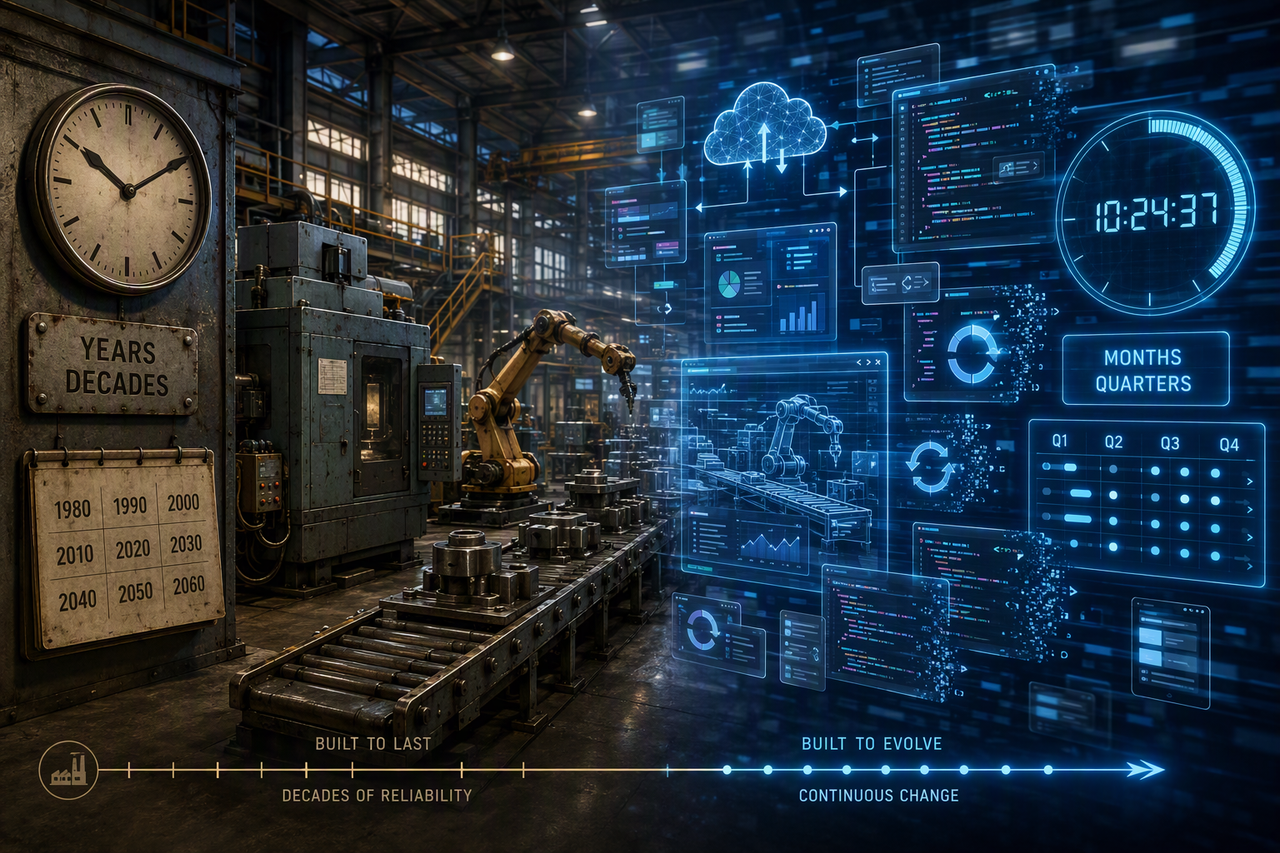
Factory equipment and business software live on completely different timelines. Most business software gets replaced every few years. A machine on the factory floor is often expected to run for fifteen, twenty, even twenty-five years. Manufacturers plan in decades. Software companies plan in fiscal quarters.
Normally you don't notice this gap. It becomes a real problem when the company behind that software changes hands, runs out of money, or simply decides the product isn't profitable enough to keep supporting. Then the plant is left with machinery built to last two decades, running on software that stopped getting support years ago.
This pattern shows up again and again in industrial engineering: once a vendor stops sending updates, plants lose access to replacement parts, security fixes, and technical help — and small problems start turning into long, expensive outages because there's no one left to call (Pacific Blue Engineering). Old, unsupported systems can also fall out of compliance with safety and industry regulations, turning a technical headache into a legal one.
This isn't hypothetical, it's already happened
Citect, one of the most widely used factory-monitoring programs in the world, was built by an independent Australian company. Schneider Electric bought it in 2006, and by 2008 it had stopped operating as its own company — it was folded into a bigger product line and eventually renamed entirely (Wikipedia). Customers kept a working product, but only because a much larger company happened to decide it was worth keeping alive — a decision made far away from any factory floor.
GE's Predix is a starker example. Launched in 2015 with huge ambitions, it convinced manufacturers around the world to build their monitoring and analytics tools directly on top of GE's own cloud platform. A few years later, GE sold off the business behind it, and the platform collapsed under its own weight — a roughly $4 billion effort that's now taught as a case study in what happens when too much gets built on one company's platform (Panorama Consulting Group, Bill Baumann, 2021). Every manufacturer who had built their tools on top of it had to untangle that dependency on someone else's schedule, not their own.
More recently, the 2025 cyberattack that shut down Jaguar Land Rover's production for six weeks shows how quickly the costs pile up once one part of the production system goes down: about £882 million (roughly $1.1 billion) in combined lost revenue, penalties, and recovery and supplier costs (DeNexus, Q3 2025 report on industrial cyber incidents). The same report estimates manufacturing worldwide is exposed to as much as $127.3 billion in potential losses from these kinds of incidents, and notes that attackers increasingly go after software vendors directly, because breaking into one vendor can open the door to dozens of that vendor's customers at once.
What losing a vendor actually costs you
It's worth looking at this from two angles, because a vendor disappearing hits the business office and the factory floor differently — and the costs add up where the two meet.
From an office/IT perspective, an abandoned piece of software becomes a permanent drag. Once a vendor stops fixing things, everything around that software keeps changing — computers get updated, browsers change, security requirements get stricter — while the old software stays frozen in place, until things simply stop working and there's no one to fix it. Security risk climbs too: outdated, unpatched software is exactly what hackers look for, and the average cost of a data breach reached $4.44 million globally in 2025, according to IBM's annual report (cited in Worthwhile, “Vendor Discontinuing Your Software? What to Do Next”). That same source notes that companies stuck maintaining old, unsupported systems can end up spending 60 to 80 percent of their entire technology budget just keeping those old systems limping along.
From the factory floor, the costs are more physical and more immediate. If the software running your control screens or monitoring systems is discontinued, there are no more safe updates for it. If the company behind your control system folds, there are no more spare parts, no more firmware updates, and your engineers are troubleshooting blind because the manuals and support articles disappeared along with the company's website. And because factory software is so often custom-built over the years — recipes, safety rules, quality checks — there's usually no simple “export” button. That knowledge is often trapped in a format only the vendor's own (now-defunct) tools can open.
Where these two worlds collide is downtime — and downtime is expensive. A survey of over 600 manufacturing and maintenance leaders across the US, UK, and Germany found that 61 percent had experienced unplanned downtime in the past year, costing an average of $1.7 million per hour, and adding up to $852 million in losses across the industry every single week (Fluke Corporation, October 2025). Losing a vendor doesn't cause downtime by itself, but it takes away nearly every tool a plant would normally use to prevent it or shorten it.
Connecting the factory floor to the business made this worse, not better
Over the last decade, most manufacturers have worked to connect their factory floor to their business systems — getting real-time production data into planning tools, applying modern analytics to what used to be purely mechanical processes. The benefits are real: better decisions, fewer surprise breakdowns, and clearer visibility for audits and regulations (Palo Alto Networks).
But connecting these two worlds also means they now share the same risks. A 2026 review of this trend points out that closing the gap between the office network and the factory network opens up the factory to threats it was historically protected from — and a lot of factory equipment simply can't be patched or updated even when a problem is known, because it was never designed to be connected to a network in the first place (Mary K. Pratt, TechTarget, September 2026). The same article points out that a lot of factory data was only ever meant to be used locally, so many companies are only now discovering how much of their production knowledge is locked inside systems that were never built to share it.
In short: connecting everything made the data more valuable — and made losing control of the software that carries it more costly.
Why building everything on one company's platform is risky
Much of the industrial software sold over the past fifteen years follows the same basic pitch: send us your data, run your systems on our platform, and we'll handle the complexity. It's an appealing offer, and it works fine — until “our platform” becomes the one thing an entire facility depends on to keep running, for a company that's supposed to operate for decades.
This is what's known as vendor lock-in, and it comes with predictable costs in every industry that's dealt with it: rising fees once switching becomes too painful, systems that don't play well with anything else, and a vendor that has little reason to keep improving a product once its customers can't easily leave (DataCore Software). The usual advice for avoiding it is consistent everywhere: use widely-supported, non-proprietary technology instead of a single company's private system, choose tools that work with more than one vendor's equipment, and negotiate contracts that guarantee you can always get your data out and keep upgrading, rather than being forced into a full replacement someday.
Manufacturing has a harder version of this problem than most industries, because what's “locked in” isn't just a database — it's a physical production line that took years to build and can't be swapped out over a weekend.
What a safer approach actually looks like
None of this is an argument against modernizing the factory floor. It's an argument for doing it in a way that doesn't just recreate the same single-vendor risk somewhere else. A few principles show up again and again in the most resilient setups being built today.
Use widely-shared, open technology instead of one company's private system. When the technology underneath isn't owned by a single vendor, it can be maintained, expanded, or replaced piece by piece — instead of everything breaking at once if one company disappears.
Keep software able to run in more than one place. Modern tools let manufacturers run the same software at the factory, in their own data center, or in the cloud — without rewriting it each time — so no single location or provider becomes a hard dependency.
Rely on technology maintained by a broad community, not one company's roadmap. A good example: a group of major companies in railways, power, and factory automation banded together in 2016 to fund long-term support for the operating system used across critical infrastructure — specifically because no single vendor could promise the multi-decade support that heavy industry actually needs. As the group's chair put it on the project's tenth anniversary, it has become “an indispensable foundation supporting railways and power grids worldwide,” precisely because its survival doesn't depend on any one company staying in business (Urs Gleim, quoted by the Linux Foundation, April 2026).
Work with the equipment you already have. Systems that connect to your existing machines and screens as-is — instead of requiring you to rip everything out and start over — mean you never put all your eggs in one proprietary basket to begin with.
Own your own data and systems from day one, rather than negotiating for it after a crisis hits. The best protection against a vendor disappearing isn't a clause in a contract promising ninety days' notice. It's making sure, from the start, that your plant already controls its own data and — ideally — has guaranteed access to the underlying software itself, so operations don't grind to a halt the day a vendor's business changes.
None of this removes risk entirely. But it moves the danger from “this depends on one company staying in business” to “this depends on a broad, open ecosystem that no single company can take down” — which is a much safer bet for anything meant to run for twenty years.
The floor and the front office are asking the same question
Plant engineers ask a practical question: if this system stops being supported tomorrow, can we still run the line, get parts, and pass an inspection? IT and security leaders ask a strategic one: does our production depend on one vendor's survival, or on something that outlasts any single company's decisions? Increasingly, these are the same question, just asked from two different desks — and the answer that satisfies both is the same: build on open, flexible foundations, and treat “what if the vendor disappears” as something you plan for, not something you hope never happens.
The next vendor shutdown notice shouldn't be the moment a plant finds out how exposed it really was.
Curious what an open, factory-to-cloud platform built for exactly this kind of resilience looks like in practice? Learn more at www.embernet.ai.
Sources
● DeNexus. “Q3 2025 OT Cyber Incidents: $329.5B in Industrial Losses.”
● Worthwhile. “Vendor Discontinuing Your Software? What to Do Next.” (citing IBM, Cost of a Data Breach Report 2025)
● Wikipedia contributors. “Citect.”
● Baumann, Bill. Panorama Consulting Group, September 1, 2021. “4 Lessons From GE Digital Transformation & Predix Platform Failure.”
● Pratt, Mary K. TechTarget, September 10, 2026. “6 IT/OT Convergence Trends IT Leaders Should Watch.”
● Palo Alto Networks. “What Is IT/OT Convergence?”
● DataCore Software. “What Is Vendor Lock-in? Costs, Risks, and Prevention Strategies.”
● Pacific Blue Engineering. “5 Signs Your Industrial Control System Is Obsolete.”
● Fluke Corporation, October 30, 2025. “Unplanned Downtime Costs Manufacturers Up to $852M Weekly.”
● Linux Foundation, April 29, 2026. “Civil Infrastructure Platform Celebrates 10 Years of Supporting Industrial-Grade Linux.”