
You own the hardware, who owns the management plane?
The question nobody asks at purchase
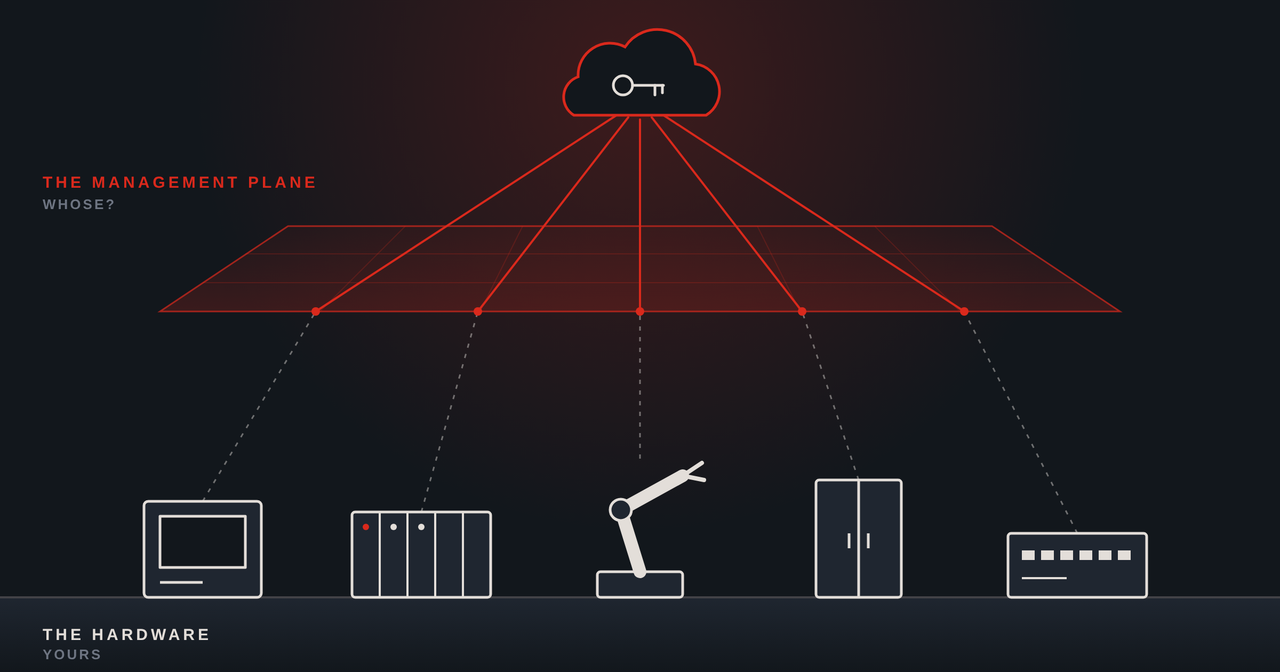
A plant buys its industrial PCs, controllers and switches outright. They sit on its floor and on its books. But owning the box says little about who decides what runs on it.
That decision lives in the management plane: the layer that pushes updates, issues licenses, grants remote access and decides whether a workload keeps running. More and more often, it belongs to a vendor and runs in a vendor’s cloud.
Law scholars Aaron Perzanowski and Jason Schultz call the wider pattern the end of ownership (Perzanowski & Schultz, 2016). Their test is simple: “If we own our purchases, we are free to make whatever lawful use of them we please.” Few plant managers could say that about the software on their own line.
Four ways the plane decides for you
Updates. On July 19, 2024, one faulty CrowdStrike update, delivered through the vendor’s own channel, crashed Windows machines worldwide. Microsoft’s David Weston put the count at 8.5 million devices, under 1% of all Windows machines (Ha, 2024). The owners did not choose that update. The management plane chose it for them.
Licensing. After Broadcom closed its VMware acquisition in late 2023, it ended perpetual licenses and moved customers to subscriptions (Hale, 2024). Some customers reported cost increases of about 1,200%, figures The ITAM Review noted it could not verify (ITAM Review, 2024). Plants running HMIs and historians on that hypervisor learned their price was set elsewhere.
Repair. In January 2025 the FTC and five states sued Deere, arguing that its control of repair software kept work at authorized dealers. The 2026 settlement requires Deere to give independent shops the same diagnostic tools as its dealers, for ten years (Stan, 2026). As that coverage put it: “Modern tractors are computers.” So are modern production lines.
Shutdown. In April 2022, Insteon’s servers went dark without notice. The app, schedules and automations stopped; the physical switches kept working (Claburn, 2022). What survived was whatever stayed local.
Cory Doctorow explains why this keeps happening: once switching costs are high, a platform can move value away from the customers it has locked in and toward itself (Doctorow, 2025). A management plane you cannot leave is exactly that kind of switching cost.
The same plane is an attack path
Whoever holds the management plane also holds a door into the plant. Dragos reports that 73% of its all-time OT incident-response cases involved compromised VPN or jump-host credentials. In its latest annual review, 81% of assessments found poor IT/OT segmentation, and only 46% found adequate OT network monitoring (Dragos, 2026).
In January 2026, the UK’s NCSC, CISA, the FBI and international partners published Secure Connectivity Principles for Operational Technology (NCSC et al., 2026; Waterfall Security, 2026). Three of its eight principles go straight to this point: limit the exposure of your connectivity, centralise and standardise network connections, and establish an isolation plan.
An isolation plan only works if the plant can cut its external links and keep producing. That is not a firewall question. It is a question of who owns the management plane.
Six questions to ask any vendor
- If your cloud or your company disappears tomorrow, what keeps running on my floor?
- If our subscription lapses, does software already deployed keep running, or can it be switched off remotely?
- Can we run the management console on our own infrastructure, including air-gapped sites?
- Do connections to our sites need inbound ports, or are they outbound-only and authenticated at both ends?
- Who holds the keys and credentials, and can we revoke your access ourselves?
- Can we export our configuration and rebuild without you?
If the answers depend on the vendor’s goodwill, the plant owns the hardware and rents everything else.
Want to see how a plant can own its management plane, not just its hardware? We invite you to get to know EmberNet at www.embernet.ai.
References
- Claburn, T. (2022, April 19). Report on the Insteon cloud shutdown. The Register. https://www.theregister.com/2022/04/19/insteon_cloud_shutdown/
- Doctorow, C. (2025). Enshittification: Why Everything Suddenly Got Worse and What to Do About It. Verso Books.
- Dragos, Inc. (2026, February 17). 9th Annual Dragos OT Cybersecurity Year in Review. https://dragos.com/blog/dragos-2026-ot-cybersecurity-year-in-review
- Ha, A. (2024, July 20). Microsoft says 8.5M Windows devices were affected by CrowdStrike outage. TechCrunch. https://techcrunch.com/2024/07/20/microsoft-says-8-5m-windows-devices-were-affected-by-crowdstrike-outage/
- Hale, C. (2024, April 3). Broadcom says complaints about VMware rising prices, subscriptions are unfair. TechRadar Pro. https://www.techradar.com/pro/broadcom-says-complaints-about-vmware-rising-prices-subscriptions-are-unfair
- ITAM Review. (2024, January 30). As some VMware products come to an end, some customers face 1200% price rises. https://itassetmanagement.net/2024/01/30/as-some-vmware-products-come-to-an-end-some-customers-face-1200-price-rises
- NCSC-UK, CISA, FBI et al. (2026, January). Secure connectivity principles for operational technology. https://www.ncsc.govt.nz/protect-your-organisation/secure-connectivity-principles-for-ot/
- Perzanowski, A., & Schultz, J. (2016). The End of Ownership: Personal Property in the Digital Economy. The MIT Press.
- Stan, A. M. (2026, July 9). The John Deere repair win isn’t about tractors. It’s about software lock-in. The Next Web. https://thenextweb.com/news/john-deere-ftc-right-to-repair-software-lock-in
- Waterfall Security. (2026). How to apply the NCSC/CISA 2026 guidance. https://waterfall-security.com/ot-insights-center/ot-cybersecurity-insights-center/how-to-apply-the-ncsc-cisa-secure-connectivity-principles-for-operational-technology-2026-guidance/